
CODESTELLE / CAREER GUIDES
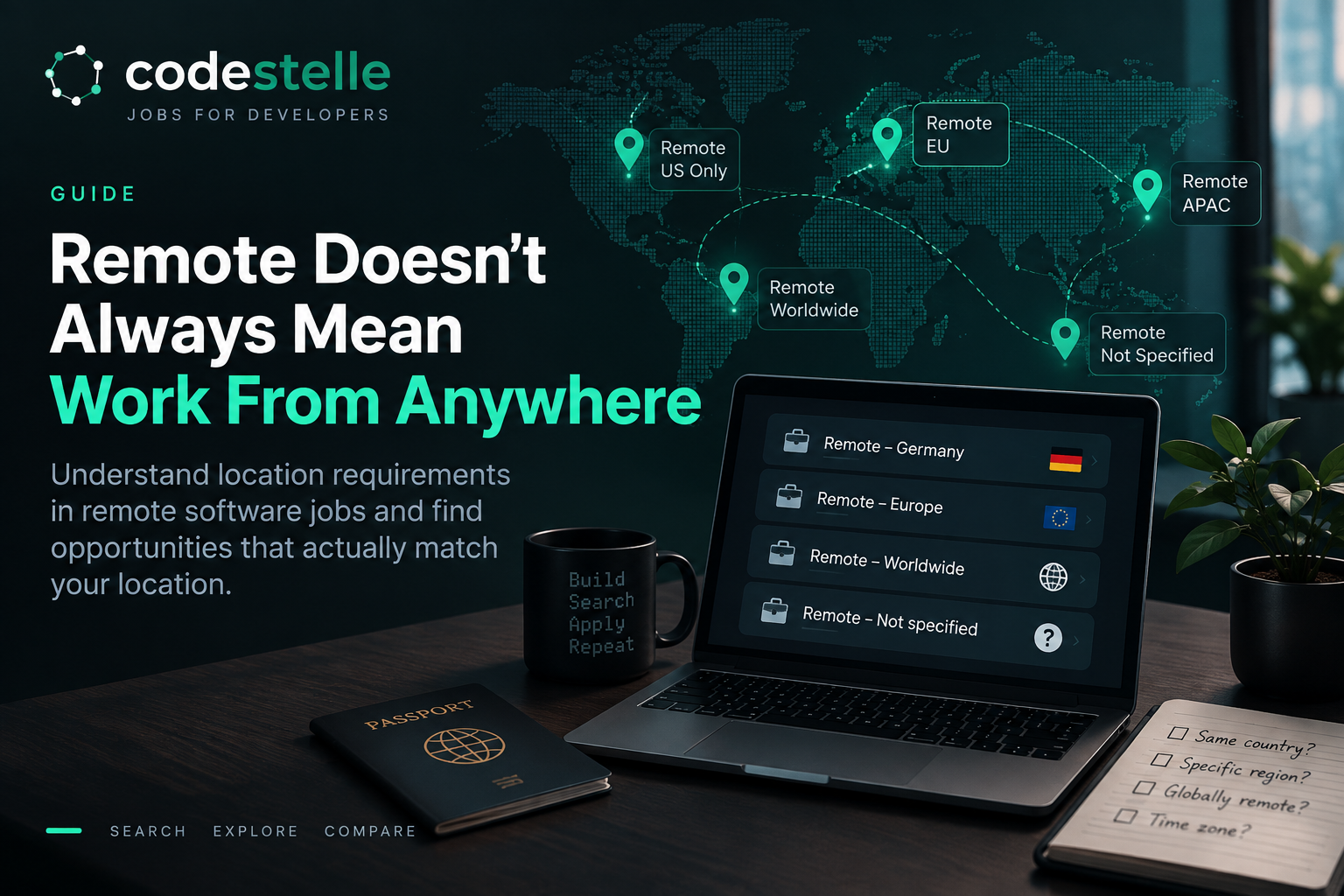
Remote Doesn’t Always Mean Work From Anywhere
A remote software job may still be limited to a specific country or region. Learn how to read work-location requirements, recognize unclear listings, and check whether “remote” actually includes your country.
Remote Doesn’t Always Mean Work From Anywhere
A job listing says Remote.
It sounds simple: the job can be done remotely.
But there is still an important question left unanswered:
Remote from where?
Some remote software jobs can be performed worldwide. Others require employees to live in a specific country, state or region.
And many job listings simply do not make the restriction clear.
Understanding that difference before applying can save a lot of time.
Remote Describes a Work Model, Not Necessarily a Location
The word "remote" usually tells you that you do not need to work from the company's office every day.
It does not automatically tell you where you are allowed to live and perform the work.
For example, these listings may all be described as remote:
- Remote within Germany
- Remote within the United States
- Remote across several European countries
- Remote within selected US states
- Remote worldwide
- Remote with no geographic scope specified
They are all remote roles, but they represent very different opportunities for someone searching internationally.
"Remote — Germany" Is Not the Same as "Germany Only"
Small wording differences matter.
Consider:
Remote — Germany
This clearly associates the role with Germany, but by itself it may not prove that candidates in every other country are excluded.
Now compare it with:
Candidates must be based in Germany.
or:
This position can be performed remotely within Germany only.
Those statements provide a much clearer geographic restriction.
This is why interpreting remote jobs requires more than looking for the word "Remote".
Worldwide Remote Should Be Explicit
A remote role should not automatically be treated as worldwide.
Clearer worldwide language might look like:
This is a globally remote role.
or:
This position can be performed from anywhere worldwide.
Without wording like this, assuming that every country is supported can be misleading.
If the listing does not clearly explain the geographic scope, the safest conclusion is often simply:
Not specified.
Regional Terms Need Careful Reading
Employers may also describe remote locations using regions rather than individual countries.
Examples include:
- European Union
- Europe
- EMEA
- Americas
- APAC
These terms should not automatically be treated as interchangeable.
For example:
Europe is not the same thing as the European Union.
Similarly, an EMEA reference does not necessarily mean that every country within Europe, the Middle East and Africa is supported.
The exact wording of the job listing matters.
Time Zones Are Another Source of Confusion
Some remote jobs require employees to overlap with a particular time zone.
For example:
You must have at least four working hours overlapping with CET.
That is useful information about working hours.
But it does not necessarily mean:
You must live in Europe.
A developer outside Europe may still be able to satisfy the required working hours.
Time-zone requirements and geographic employment restrictions are related, but they are not the same thing.
Work From Anywhere Policies Can Be Temporary
Another phrase that can easily be misunderstood is "work from anywhere."
Some companies allow employees to work from another country for a limited number of days each year.
For example:
Employees may work from abroad for up to 20 days per year.
That is a useful benefit.
It does not mean the position is permanently available as a worldwide remote role.
The employee may still need to maintain their normal working location in a specific country.
Visa Sponsorship Is a Separate Question
Work location and visa sponsorship should also be evaluated separately.
A company may allow international candidates to apply while still requiring the successful candidate to relocate.
A listing might therefore have a combination such as:
- Job based in Germany
- International applications accepted
- Employee must work from Germany
- Relocation assistance available
- Visa sponsorship not specified
None of these statements automatically implies the others.
In particular:
Relocation support does not automatically mean visa sponsorship.
And:
Visa sponsorship does not mean the job can be performed remotely from another country.
What If the Listing Doesn't Say?
This is extremely common.
A job might simply say:
Remote
without explaining the geographic scope.
In that situation, it is tempting to assume the best interpretation.
But the listing has not actually provided enough information.
A more accurate classification is:
Work location not specified.
You may still want to apply or ask the employer.
The important point is knowing that the location requirement is unclear rather than assuming that remote means worldwide.
Three Useful Ways to Read Remote Jobs
When reviewing a remote software job, it can help to separate listings into three broad groups.
Your Location Is Explicitly Included
The listing clearly includes your country, region or a worldwide scope that covers your selected working location.
Your Location Is Explicitly Restricted
The listing clearly limits the role to a location that does not include where you want to work.
The Requirement Is Unclear
The listing says remote but does not provide enough reliable information about geographic scope.
The third category matters.
Not every unclear job should be treated as incompatible.
Sometimes the employer simply has not explained the requirement clearly.
Check the Evidence, Not Just the Label
A green "Remote" badge can be useful for discovering jobs.
But it cannot explain every geographic restriction hidden inside the job description.
The actual wording may contain the important detail:
Candidates must reside in the United States.
or:
Remote work is available in Germany, Austria and the Netherlands.
or:
This is a globally remote position.
That evidence provides much more information than the Remote label alone.
Codestelle's Work Location Checker
Codestelle includes a Work Location tool designed around this problem.
Choose the country you want to work from and optionally enter a role or technology.
Codestelle then analyzes supported location information in current remote software job listings and separates the results into:
- Explicit location matches
- Explicit location restrictions
- Location unclear
When location evidence is available, you can inspect the wording behind the result.
The goal is not to tell you that you are legally eligible for a job.
It is to make the location requirements stated by the employer easier to understand.
Does "Remote" Include Your Country?
If you are searching for remote software jobs, check the location requirement before assuming that the role can be performed from anywhere.
You can try the Work Location Checker on Codestelle:
Check remote work-location requirements:
https://codestelle.com/work-location
Or browse current remote software opportunities:
Browse remote software jobs:
https://codestelle.com/jobs/remote
Put your next step into motion
Explore current software roles and save a search to hear about new opportunities.
Explore matching jobs